


Medically reviewed by the clinical team at The Farm Rehab. Last updated: October 2026.
To quit drinking, decide on a clear goal and a quit date, tell someone you trust, and take alcohol out of your home so the choice is easier to keep. If you drink daily or in large amounts, speak with a doctor before you stop, because alcohol withdrawal can be medically dangerous and sometimes needs supervision. After that, you get through cravings one at a time, plan ahead for social situations, and lean on support, whether that is your family doctor, a counsellor, a peer group, or a treatment program.
Quitting is rarely one big moment of willpower. It is a series of small, practical steps repeated over several weeks. This guide walks through those steps in order, explains when stopping on your own is risky, and shows what changes in your body as the days and months pass.
What is the short version?
The short answer is to plan ahead, make the process safer, and get support early rather than waiting until things feel out of control. Here are the main points before the detail.
- Choose a quit date and write down a reason you can come back to on hard days.
- If you drink every day or heavily, check with a doctor first. Stopping suddenly can bring on serious withdrawal.
- Clear alcohol out of your home and plan for the first two weeks, which are usually the toughest.
- Expect cravings, and know that most pass within about 15 to 20 minutes whether or not you drink.
- You do not have to do this alone. In Ontario, free and confidential help is available any time through ConnexOntario at 1-866-531-2600.
How do you quit drinking, step by step?
You quit drinking by preparing first, then changing your surroundings and routines so that not drinking becomes the path of least resistance. Work through these steps roughly in order.
- Name your reason. Write down why you want to stop, in your own words. It might be your sleep, your mood, your kids, your health, or your money. Keep it somewhere you will see it, because a specific reason is easier to hold onto at 9 p.m. on a Friday than a vague wish to drink less.
- Track what you actually drink for a week. Most people underestimate. A standard drink in Canada contains about 13.45 grams of pure alcohol, which works out to a 341 mL bottle of 5% beer, a 142 mL glass of 12% wine, or a 43 mL shot of 40% spirits (Canadian Centre on Substance Use and Addiction). Counting honestly tells you how big a change you are making and whether a doctor should be involved.
- Talk to a doctor if you drink daily or heavily. This step is not optional for everyone. If you drink most days, or several drinks a day, your body may have adapted to alcohol, and stopping abruptly can be dangerous. A doctor can tell you whether you need a medically supervised detox rather than quitting on your own.
- Set a quit date and tell someone. Pick a date within the next week or two, close enough to feel real but far enough away to prepare. Then tell at least one person. Saying it out loud makes it harder to quietly back out, and it gives you someone to call on a rough night.
- Clear your space. Pour out or give away the alcohol in your home. Remove the wine rack, the bottles in the fridge, the backups in the cupboard. You cannot rely on willpower alone when a drink is ten steps away, so make it less convenient to reach for one.
- Plan for your triggers. Notice when you usually drink. For many people it is a time of day, a place, a feeling such as stress or boredom, or certain company. Write down your top three triggers and a simple plan for each, so you are not deciding in the heat of the moment.
- Replace the ritual, not just the drink. If a drink marks the end of your workday, put something else in that slot: a walk, a non-alcoholic drink you actually enjoy, a call to a friend, a shower, or cooking. The habit needs a new ending, not just a missing one.
- Line up real support. That can be your family doctor, a counsellor, a peer group such as SMART Recovery or Alcoholics Anonymous, or a structured alcohol treatment program. Support is not a sign that you are failing. It is what helps the change hold.

Should you taper or quit cold turkey?
If you are a light or occasional drinker, stopping outright is usually safe. If you drink heavily or every day, quitting cold turkey can be dangerous, and a slow taper or a medically supervised detox is the safer route.
Here is why the difference matters. When someone drinks heavily for a long time, the brain adapts to alcohol by increasing its own excitatory activity to stay balanced. Take the alcohol away suddenly and that activity has nothing to push against, which can cause tremors, high blood pressure, hallucinations, seizures, and in severe cases delirium tremens, a medical emergency. CAMH notes that alcohol is one of the few substances where withdrawal itself can be life-threatening.
Tapering means cutting your intake down gradually instead of stopping all at once, which can ease the shock to your system. It sounds simple, but it is hard to do safely on your own, because it depends on an honest baseline and steady discipline that cravings work against. For anyone who drinks heavily, doing this under medical guidance is far safer. Our alcohol withdrawal timeline gives a closer look at what the first 72 hours can involve.
What happens to your body when you stop drinking?
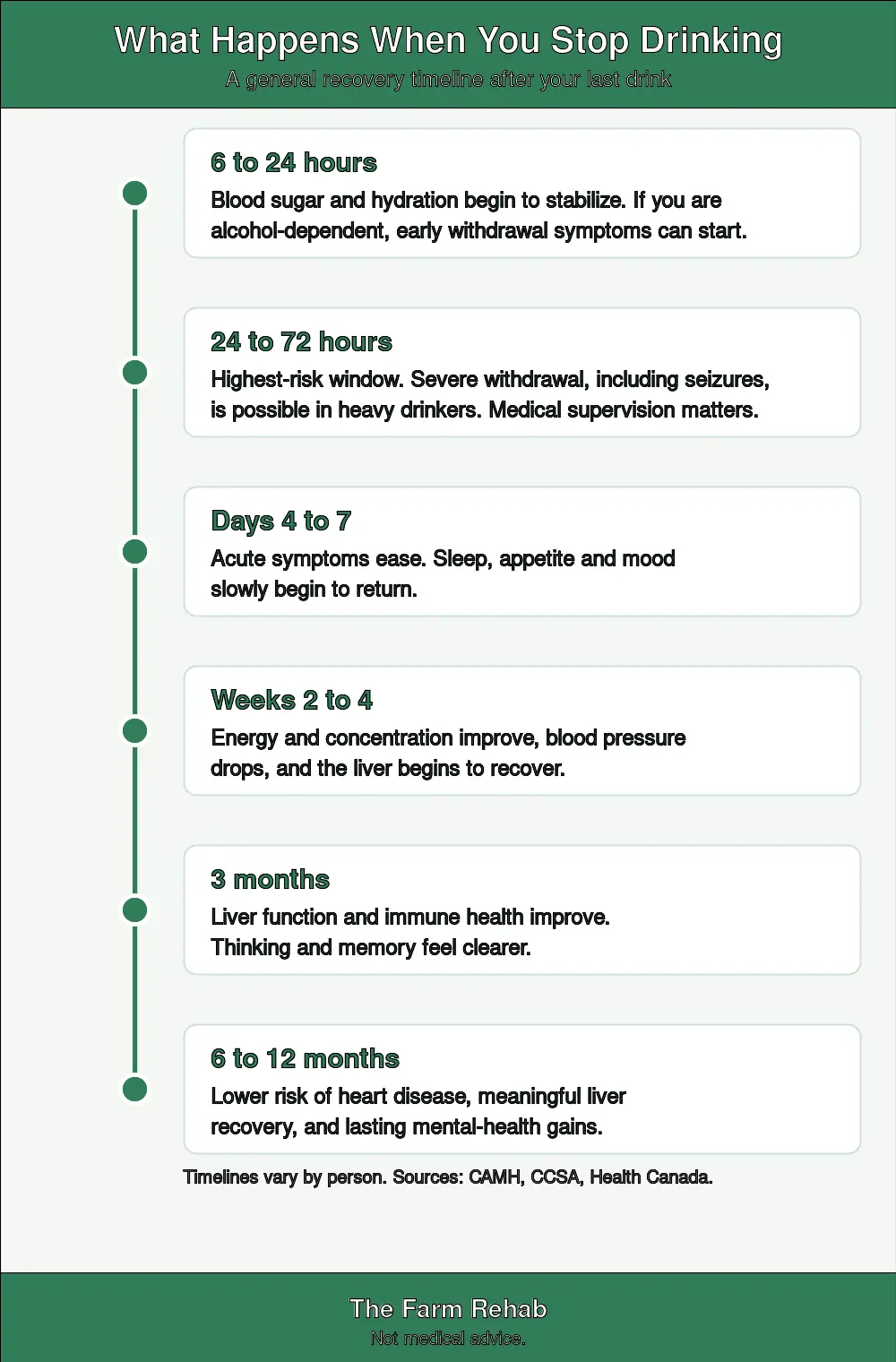
Your body begins to recover within hours of your last drink, though the first few days can also carry the most risk if you are physically dependent. Early on, the nervous system has to recalibrate, which is where withdrawal symptoms come from. Over the following weeks and months, sleep, mood, blood pressure, and liver health tend to improve. The timeline below is a general guide, and everyone is different.
| Time since last drink | What tends to happen |
|---|---|
| 6 to 12 hours | Blood sugar and hydration start to stabilize. In dependent drinkers, early withdrawal can begin: anxiety, sweating, shaky hands, and trouble sleeping. |
| 24 to 72 hours | The highest-risk window. Severe withdrawal, including seizures and delirium tremens, is possible in heavy drinkers. This is when medical supervision matters most. |
| Days 4 to 7 | Acute symptoms usually ease. Sleep, appetite, and mood slowly begin to settle. |
| Weeks 2 to 4 | Energy and concentration improve, blood pressure often drops, and the liver starts to recover. |
| 3 months | Liver function and immune health improve. Many people notice clearer thinking and steadier memory. |
| 6 to 12 months | Lower risk of heart disease, meaningful liver recovery, and lasting gains in mood and mental health. |
How do you handle cravings and social pressure?
Cravings are temporary, and the goal is to ride them out rather than fight them head on. A craving usually peaks and fades within 15 to 20 minutes, so the skill is getting through that window. Delay and distract: drink a glass of water, step outside, text someone, or do something with your hands. Many people find it helps to notice the craving like a wave, name it, and wait for it to pass instead of arguing with it.
Social pressure is its own challenge, especially early on. Decide your answer before you are in the room. A short line such as, I am not drinking tonight, or, I am taking a break from alcohol, is usually enough, and you owe no one a long explanation. Hold a non-alcoholic drink so your hands are busy and you are not fielding offers. For the first while, it is reasonable to skip the events most likely to test you, or to arrive late and leave early. Protecting your early sobriety is not rude. It is sensible.
Keep a short list of go-to responses and one person you can text when a craving hits. Having a plan ready turns a hard moment into a familiar one.
When is quitting at home not safe?
Quitting at home is not safe if you have a history of withdrawal seizures or delirium tremens, drink heavily every day, or have serious physical or mental health conditions alongside your drinking. In those situations, withdrawal can turn dangerous quickly, and medical detox is the safer choice.
Call 9-1-1 or go to the nearest emergency department if you or someone else has any of these during withdrawal:
- A seizure, or a first-ever seizure.
- Confusion, severe agitation, or seeing or hearing things that are not there.
- A racing heart, chest pain, or a dangerously high temperature.
- Repeated vomiting that makes it impossible to keep fluids down.
If you are not sure how risky quitting is for you, treat that uncertainty as a reason to get medical advice before you stop. A short conversation with a doctor or a call to ConnexOntario can tell you whether home is a safe place to do this.
Frequently asked questions
Is it safe to quit drinking cold turkey?
For light or occasional drinkers, stopping suddenly is usually safe. For heavy or daily drinkers, it can be dangerous. Alcohol is one of the few drugs where sudden withdrawal can cause seizures and delirium tremens, which can be fatal. If you drink heavily or every day, talk to a doctor or arrange a medically supervised detox rather than stopping on your own.
How long do alcohol cravings last?
Individual cravings tend to peak and pass within about 15 to 20 minutes. They are strongest in the first week or two, and usually become less frequent and less intense over the following weeks. Cravings can still surface months later around certain triggers, which is why a written plan and ongoing support help.
What happens to your body when you stop drinking?
In the first day or two, dependent drinkers may feel withdrawal as the nervous system adjusts. After that, most people see steady gains: better sleep, more stable mood and energy, lower blood pressure, and improving liver and immune health over the following months. The first 72 hours carry the most medical risk for heavy drinkers, which is where supervision matters.
If drinking has become hard to control, you do not have to sort it out alone. The Farm Rehab offers medically supported alcohol treatment in Ontario, from supervised detox through residential care and aftercare. You can reach our admissions team to talk through your options confidentially and at your own pace.
This article is for general information and is not medical advice. Always speak with a qualified healthcare professional about your own situation, especially before stopping alcohol if you drink heavily or daily.
If you need help now: In Ontario, call ConnexOntario at 1-866-531-2600 for free, confidential addiction support any time. If you or someone else is thinking about suicide or in crisis, call or text 9-8-8, the Suicide Crisis Helpline. In a medical emergency, call 9-1-1.

