

· Updated

Medically reviewed by the clinical team at The Farm Rehab. Last updated: October 2026.
The stages of change are the six steps most people move through when they change a behaviour like drinking or drug use: precontemplation, contemplation, preparation, action, maintenance, and termination. The model comes from Canadian and American researchers James Prochaska and Carlo DiClemente, who noticed that change is rarely a single decision. It is a process that unfolds over time, often with a few loops backward before it holds. Knowing which stage someone is in helps families offer the right kind of support and helps clinicians match treatment to where a person actually is, not where we wish they were.
This guide walks through each stage, shows what it looks like day to day, explains where relapse fits, and covers how good treatment meets a person at their own starting point.
What are the stages of change?
The stages of change are a map of how people give up a harmful habit and build a healthier one. Prochaska and DiClemente developed this framework, called the Transtheoretical Model, in the early 1980s after studying how smokers quit. They found that readiness is not fixed. A person can be nowhere near ready one month and seriously preparing the next, and the move between those points follows a recognisable pattern.
The practical value is simple. Pushing someone toward action when they have not yet accepted there is a problem usually backfires. It raises defensiveness and ends conversations. When you can tell that a family member is only starting to weigh the costs of their drinking, you can have a very different conversation than you would with someone who has already asked for help. The Centre for Addiction and Mental Health (CAMH) uses stage-based thinking in its clinical work for this reason: care lands better when it fits the person’s readiness.
One point worth holding onto early. Moving through the stages is not a straight line. Most people cycle through some of them more than once before a change sticks, and that is normal rather than a sign of failure.
What are the six stages of change?
The six stages are precontemplation, contemplation, preparation, action, maintenance, and termination. Each one describes a different relationship to the behaviour and a different task the person is working on. The table below sets out what each stage looks like and what tends to help at that point.
| Stage | What it looks like | What helps |
|---|---|---|
| 1. Precontemplation | No intention to change soon. The person does not see the drinking or drug use as a problem, or feels change is impossible. Often more aware of the costs of quitting than the costs of continuing. | Honest, non-judgmental information. Raising doubt gently. Keeping the relationship open. |
| 2. Contemplation | Aware something is wrong and thinking about change, usually within the next six months, but stuck in two minds. Sees reasons to stop and reasons to keep going at the same time. | Weighing the pros and cons out loud. Naming what they would gain. No pressure to commit yet. |
| 3. Preparation | Intends to act soon, often within a month, and has started taking small steps: booking a call, telling someone, cutting back, looking into options. | A concrete plan. Practical help removing barriers. Information on detox and treatment. |
| 4. Action | Actively changing the behaviour: stopping or cutting down, entering treatment, reshaping daily routines. The most visible stage, and often the most demanding. | Structure, medical support where needed, and steady encouragement. Managing cravings and triggers. |
| 5. Maintenance | The change has held for months. The focus shifts from stopping to staying stopped, protecting new routines, and avoiding a return to old patterns. | Relapse prevention, ongoing support, rebuilding a life that does not revolve around substances. |
| 6. Termination | The new behaviour is fully settled. The old temptation holds little pull, even under stress. Many people in long-term recovery describe a steady maintenance rather than a final finish line. | Continued connection and purpose. Staying alert to complacency. |
Some versions of the model add relapse as a separate stage. We cover where relapse fits further down, because it is better understood as a return to an earlier stage than as a step forward.
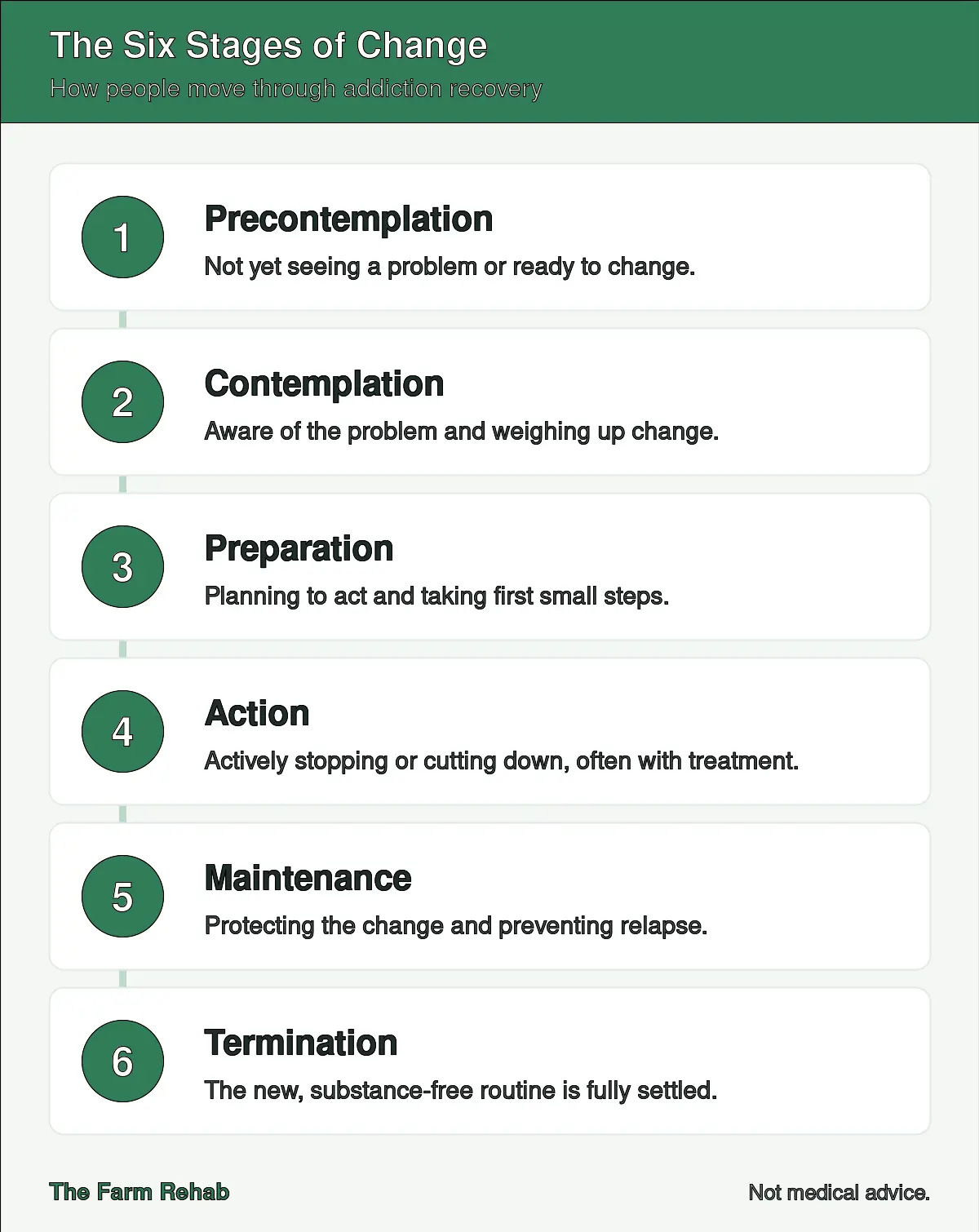
Why do the stages of change matter in treatment?
They matter because the right help at the wrong moment still fails. A person in precontemplation and a person in preparation need almost opposite things, and treating them the same wastes the opening you have. This is the core reason stage-based approaches took hold in addiction care across Ontario and beyond.
Take two examples. Someone in contemplation benefits most from a conversation that helps them weigh things honestly, the approach behind motivational interviewing, which CAMH identifies as an evidence-based counselling method for substance use. Hand that same person a rigid 30-day plan and they often retreat. Meanwhile, someone in the action stage who is managing alcohol withdrawal needs clinical structure and sometimes medical supervision, not more gentle exploration of whether they have a problem. The stage tells you which tool to reach for.
The model also reframes setbacks. When progress is understood as a cycle, a return to drinking is read as information about what the plan missed, not proof that the person is beyond help. That shift changes how clinicians respond and how families cope, and it keeps people in contact with support instead of disappearing in shame.
How can you support someone at each stage?
You support someone best by matching your response to their stage rather than your own urgency. The hardest part for most families is resisting the pull to push someone into action before they are ready. Here is what tends to help, stage by stage.

Precontemplation. Stay connected and keep judgment out of the conversation. Share what you notice in plain, caring terms and let it sit. Ultimatums usually harden the position. The goal is to keep the door open, not to win the argument today.
Contemplation. Help them think it through rather than deciding for them. Ask what worries them about their drinking or use, and what a change might give them. People are more moved by reasons they say out loud themselves than by reasons they are handed.
Preparation. Get practical. Help with the logistics that stall people: finding a program, arranging time off, sorting childcare or transport, making the first call. This is the stage where offering to help with a confidential admissions conversation can turn intention into action.
Action. Offer steady, concrete support without taking over. Celebrate the effort, not just the outcome. If the substance is one where stopping carries medical risk, such as alcohol or benzodiazepines, this is the point to involve professionals and consider supervised medical detox.
Maintenance. Keep showing up after the crisis passes. Support often fades once the obvious danger is over, which is exactly when a strong routine and a relapse prevention plan matter most. Help protect the new habits rather than testing them.
Throughout, look after yourself too. Supporting someone through addiction is draining, and organisations like Al-Anon exist because families need their own support. You cannot pour from an empty cup, and burning out helps no one.
Where does relapse fit in the stages of change?
Relapse is a return to substance use after a period of change, and in this model it is best understood as a slip back to an earlier stage rather than a failure or a stage of its own. Someone who has been in maintenance for several months might relapse and move back into contemplation or preparation, then work forward again. Prochaska and DiClemente described this looping as a normal feature of how people change, not an exception to it.
The research backs this up. Addiction is a chronic, relapsing condition, and relapse rates are comparable to those of other long-term health conditions like hypertension and asthma. That framing is not an excuse. It is a reason to plan for setbacks rather than be floored by them. A relapse that is caught early and met with support often becomes a short detour instead of a full return to old patterns.
What matters most is what happens next. Shame tends to deepen a relapse, while quick reconnection with support tends to shorten it. This is where a written structured treatment program and a clear plan for high-risk moments earn their keep, because they turn a vague intention to cope into specific steps a person can actually follow on a hard day.
What is stage-matched care?
Stage-matched care means the treatment a person receives is chosen to fit the stage of change they are in, so the help meets them where they are. It is the practical payoff of the whole model. Rather than running everyone through an identical program, clinicians assess readiness first and build from there.
In practice this looks like a continuum. A person still in contemplation might start with assessment and motivational counselling. Someone in preparation or action moves into structured treatment, which may include medical detox, residential or inpatient care, group and individual therapy, and treatment for any co-occurring mental health condition. As the change holds, the focus shifts toward maintenance: aftercare, peer support, and relapse prevention. The stages also connect to the wider picture of why addiction is hard to stop on willpower alone, something the 4 C’s of addiction help explain.
At The Farm Rehab in Stouffville, Ontario, assessment at intake is used to meet each person at their stage rather than forcing a single pathway. If you are supporting someone who is getting close to ready, the most useful thing you can do is have the practical option available for the moment they say yes.
Frequently asked questions
What are the 6 stages of change?
The six stages are precontemplation (not yet seeing a problem), contemplation (aware and weighing it up), preparation (planning to act soon), action (actively changing), maintenance (protecting the change over time), and termination (the new behaviour is fully settled). They come from Prochaska and DiClemente’s Transtheoretical Model.
Which stage of change is the hardest?
It varies by person, but many people find contemplation the most uncomfortable, because they can see the problem clearly yet feel stuck between stopping and continuing. The action stage is usually the most demanding in terms of effort and risk, especially when withdrawal needs medical support. There is no single hardest stage for everyone.
Is relapse one of the stages of change?
Some versions of the model list relapse as a stage, but it is more accurate to see it as a return to an earlier stage rather than a step of its own. A relapse does not erase progress. It signals that the plan needs adjusting, and with quick support most people move forward again.
Getting help in Ontario
Wherever you or someone you love sits on this map, help is available and recovery is possible. If you want to talk through options, The Farm Rehab offers confidential assessments and can explain what treatment at each stage involves. You can reach our admissions team whenever you are ready.
This article is for general information and is not medical advice. For guidance about your own situation, speak with a qualified healthcare professional.
If you need help now: ConnexOntario offers free, confidential addiction support 24/7 at 1-866-531-2600. For mental health crises, call or text the 9-8-8 Suicide Crisis Helpline. In an emergency, call 9-1-1.

