


Medically reviewed by the clinical team at The Farm Rehab. Last updated: November 2026.
The signs of alcoholism fall into three groups. There are physical signs, such as rising tolerance, withdrawal symptoms, and health problems that keep getting brushed aside. There are behavioural signs, like drinking more than you meant to, hiding how much you drink, or stepping back from people and plans. And there are psychological signs, including strong cravings and a habit of drinking to steady your mood. Clinically, these patterns are measured against the 11 criteria for alcohol use disorder (AUD) in the DSM-5. When two or more have shown up in the past year, that meets the threshold for AUD, and treatment is available across Ontario.
If you are reading this about yourself or someone you love, the goal here is clarity, not judgment. Alcohol use disorder is a treatable health condition, and noticing the signs early tends to make recovery easier.
What are the signs of alcoholism?
The signs of alcoholism are the physical, behavioural, and psychological changes that appear when drinking has moved from a habit to a dependence. No single sign confirms a problem on its own. What matters is the pattern: several signs showing up together, getting worse over time, and continuing even after they start causing harm.
“Alcoholism” is the everyday word. In a clinical setting, doctors in Canada use the term alcohol use disorder, which the Centre for Addiction and Mental Health (CAMH) describes as a pattern of alcohol use that a person struggles to control despite the consequences. The DSM-5, the diagnostic manual clinicians rely on, folded the older labels of “alcohol abuse” and “alcohol dependence” into one disorder that runs from mild to severe. We cover that scale further down.
One thing worth saying plainly: a person can hold down a job, pay the bills, and still have a serious drinking problem. This is often called being a high-functioning alcoholic, and it is one of the reasons the signs are so easy to miss, or explain away, for years.
What are the physical signs of alcoholism?
The physical signs of alcoholism show up in the body and often appear as drinking increases. The clearest ones are tolerance and withdrawal: needing more alcohol to feel the same effect, and feeling unwell when the alcohol wears off.
Common physical signs include:
- Rising tolerance. Drinking more than before to reach the same feeling, or being able to drink amounts that would have floored you a year ago.
- Withdrawal symptoms. Shaking hands, sweating, nausea, a racing heart, anxiety, or trouble sleeping in the hours after the last drink. Severe withdrawal can bring seizures and should be treated as a medical emergency.
- Morning drinking. Needing a drink in the morning to steady the shakes or get going.
- Changes in appearance. Weight loss or gain, a flushed or puffy face, broken capillaries, and poor skin.
- Sleep and energy problems. Broken sleep, constant fatigue, and low energy that does not lift.
- Stomach and liver complaints. Ongoing nausea, pain under the ribs on the right side, or a diagnosis of fatty liver or raised liver enzymes.
- Memory gaps. Blackouts, where you cannot recall part of a night, or longer-term memory and thinking problems linked to heavy drinking.
Some of these signs point to real medical risk. Long-term heavy drinking can lead to wet brain (Wernicke-Korsakoff syndrome), a serious thiamine-related brain condition, and withdrawal itself can be dangerous without medical support. That is why stopping heavy, daily drinking is safest under supervision rather than alone.
What are the behavioural and psychological signs?
The behavioural and psychological signs of alcoholism are the changes in how a person acts, thinks, and feels around alcohol. These often appear before the physical signs, and they are usually what family and friends notice first.
Behavioural signs to watch for:
- Drinking more, or for longer, than intended, even after deciding to cut back.
- Failed attempts to stop or slow down.
- Hiding bottles, drinking in secret, or lying about how much was consumed.
- Pulling away from hobbies, friends, or family in favour of drinking.
- Letting responsibilities slide at work, at school, or at home.
- Drinking in risky situations, such as before driving.
- Organizing the day around when and where the next drink will happen.
Psychological signs tend to sit underneath the behaviour:
- Cravings. A strong, sometimes overwhelming urge to drink that is hard to think past.
- Drinking to cope. Using alcohol to manage stress, anxiety, low mood, or sleep.
- Irritability and mood swings, especially when alcohol is not available.
- Guilt or defensiveness about drinking, and anger when someone raises it.
- Loss of control, the sense that drinking has its own momentum and willpower alone is not enough.
The Canadian Centre on Substance Use and Addiction (CCSA) notes that drinking to cope with difficult feelings is a common path into dependence, which is one reason alcohol problems and mental health conditions so often travel together.
The signs can read differently depending on where you are standing. When you are the one drinking, the clearest signals are often internal: the broken promises to cut back, the quiet planning around alcohol, the relief when a drink is finally in hand. When you are watching someone you love, you tend to see the outside first, the missed commitments, the defensiveness, the smell of alcohol at odd hours, the sense that their personality shifts after a few drinks. Both views are valid, and neither requires certainty before you act. Naming what you notice, gently and without accusation, is often the first useful step.

What are the DSM-5 criteria for alcohol use disorder?
The DSM-5 lists 11 criteria for alcohol use disorder, and a doctor counts how many apply over the past 12 months to make a diagnosis. Meeting 2 to 3 criteria is considered mild, 4 to 5 is moderate, and 6 or more is severe. Here are the 11 criteria in plain language.
| # | DSM-5 criterion (plain language) |
|---|---|
| 1 | Drinking more, or longer, than you meant to |
| 2 | Wanting to cut down or stop, and not being able to |
| 3 | Spending a lot of time drinking or recovering from it |
| 4 | Strong cravings or urges to drink |
| 5 | Drinking getting in the way of work, school, or home |
| 6 | Keeping on drinking even though it causes relationship problems |
| 7 | Giving up activities you used to enjoy in order to drink |
| 8 | Drinking in situations where it is physically risky |
| 9 | Continuing to drink despite a physical or mental health problem it causes or worsens |
| 10 | Needing more alcohol for the same effect (tolerance) |
| 11 | Withdrawal symptoms, or drinking to avoid them |
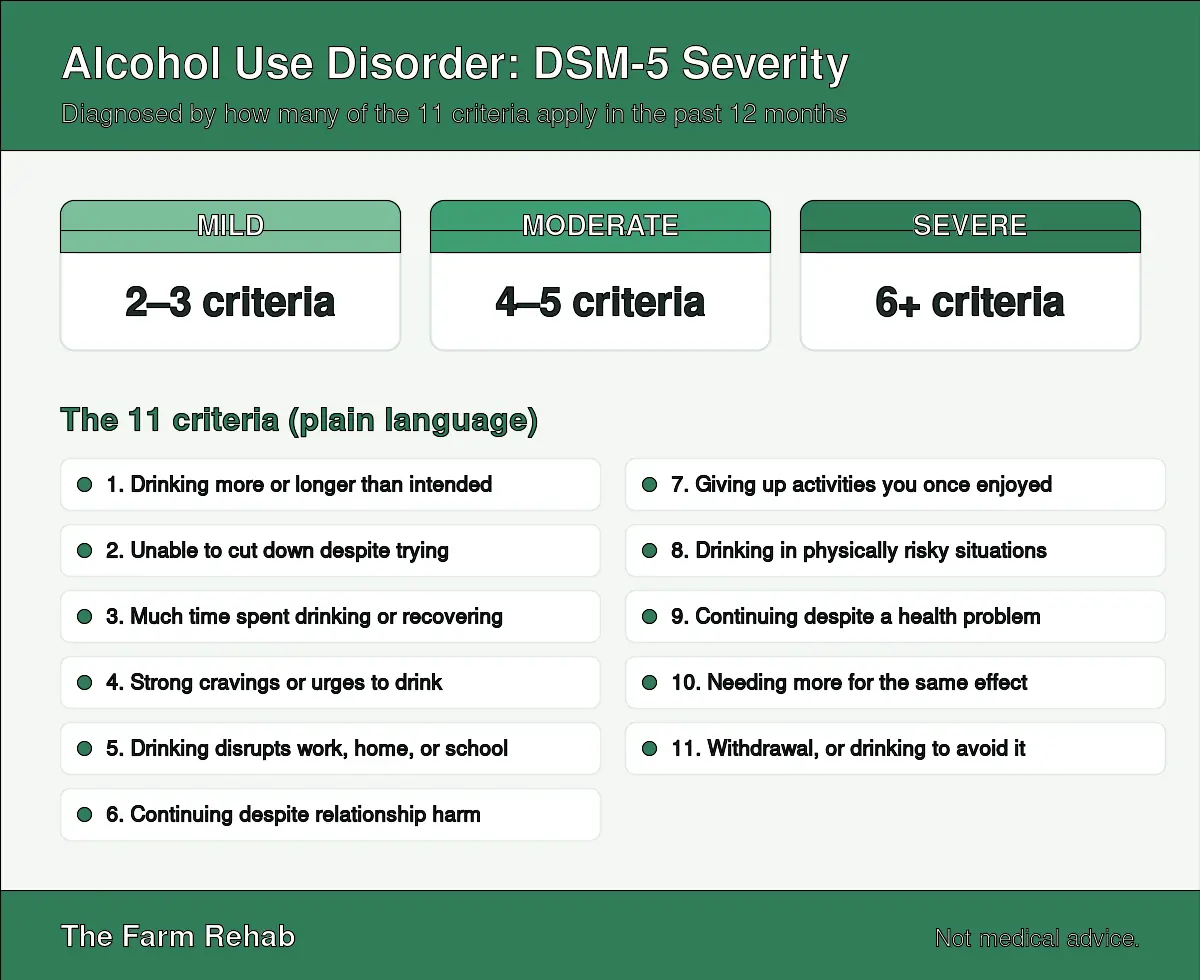
This scale is useful for two reasons. It shows that alcohol use disorder is a spectrum rather than a line you either cross or do not, and it gives a shared language for what is otherwise a very personal struggle. You do not need to count your own criteria to deserve help. If drinking is causing problems in your life, that is reason enough to talk to someone. You can learn more about the diagnosis in our guide to what alcohol use disorder is.
How does alcoholism progress through stages?
Alcoholism usually develops gradually, moving from social or occasional drinking toward regular use, growing dependence, and eventually a loss of control. It rarely happens overnight, which is part of why the early stages are easy to overlook.
A common way to describe the progression is in four broad stages. In the early stage, drinking increases and tolerance starts to build, though life still looks normal from the outside. In the middle stage, drinking becomes more regular, the first withdrawal symptoms appear, and people begin to notice changes in mood or reliability. In the later stage, drinking feels necessary rather than optional, and work, health, and relationships start to suffer in visible ways. In the chronic stage, physical dependence is established, health problems mount, and stopping without medical help becomes genuinely risky.
These stages are a guide, not a timetable. People move through them at different speeds, and some signs appear out of order. The useful takeaway is that the condition tends to get worse on its own, and that acting earlier, at the first cluster of signs, is easier than waiting for a crisis. If you want help spotting the early pattern, our article on the early warning signs of alcohol addiction goes into more detail.
How do you get help for alcoholism in Ontario?
Getting help for alcoholism in Ontario usually starts with one conversation, either with your family doctor, a provincial helpline, or a treatment centre directly. From there, care can range from counselling and community programs to medically supervised detox and residential treatment, depending on how severe the drinking is and what else is going on in your life.
A good first call is ConnexOntario, the province’s free, confidential helpline, reachable 24/7 at 1-866-531-2600. It can point you to publicly funded services near you. If daily or heavy drinking is involved, stopping suddenly on your own can be dangerous, so supervised withdrawal matters. Our page on medical detox in Ontario explains what that process looks like and why it is safer than quitting cold at home.
What treatment involves depends on the person. Some people do well with outpatient counselling and community support such as peer groups. Others, especially where tolerance and withdrawal have set in, benefit from residential care that starts with medical detox and continues with structured therapy. Cost and funding vary across public and private options in Ontario, and worry about paying should not stop you from making that first call. A helpline or admissions team can walk you through what is available, including publicly funded services, before you commit to anything.
At The Farm Rehab, our residential program near Stouffville combines medical detox, individual and group therapy, and planning for life after treatment. If any of the signs in this guide sound familiar, you can reach out through our alcohol addiction treatment page or speak with our team through admissions. There is no pressure in asking a question, and recovery is possible at any stage.
Frequently asked questions
What are the first signs of alcoholism?
The first signs of alcoholism are usually behavioural rather than physical. People often start drinking more than they planned, find it hard to stop at one or two, begin drinking to relax or cope, and grow defensive when someone mentions it. Rising tolerance, where it takes more alcohol to feel the same effect, is one of the earliest physical signs. These changes can be subtle for a long time, which is why patterns matter more than any single incident.
What are the 11 criteria for alcohol use disorder?
The 11 DSM-5 criteria cover drinking more than intended, failed attempts to cut down, spending a lot of time drinking or recovering, cravings, drinking that interferes with responsibilities, continued drinking despite relationship problems, giving up other activities, drinking in risky situations, continuing despite health problems, tolerance, and withdrawal. Meeting 2 to 3 points to mild alcohol use disorder, 4 to 5 to moderate, and 6 or more to severe. Only a qualified professional can make the diagnosis.
Is alcoholism a disease or a choice?
Major health bodies, including CAMH, describe alcohol use disorder as a medical condition, not a failure of willpower. Alcohol changes the brain’s reward and stress systems over time, which is what makes cravings and loss of control so hard to override by choice alone. That framing matters because it points toward treatment that works, such as medical care, therapy, and support, rather than blame. You can read more in our explainer on the 4 C’s of addiction.
This article is for general information and is not medical advice. For guidance about your own situation, please speak with a qualified healthcare professional.
If you or someone you know needs help now: Call ConnexOntario at 1-866-531-2600 for free, confidential addiction support, available 24/7. If you are in emotional distress or thinking about suicide, call or text 9-8-8, the Suicide Crisis Helpline. In a medical emergency, call 9-1-1.

